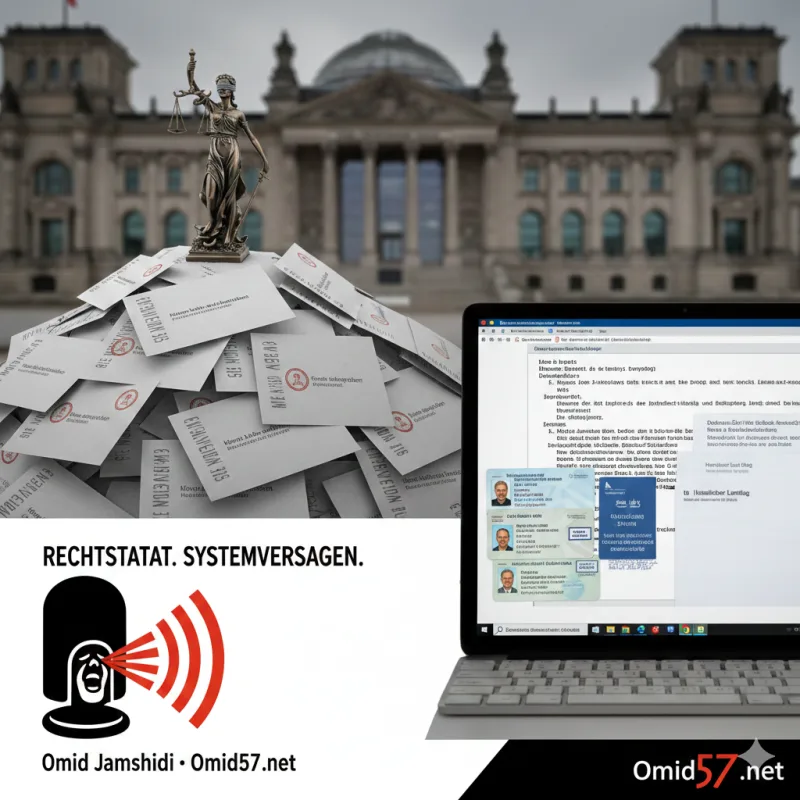
In 2023, I was sacked from my job in the public service of Rhineland-Palatinate, within the Ministry of Science and Health (MWG), under deeply discriminatory circumstances. Since that day, I've approached every single complaints and oversight body I knew. The response was pretty much the same everywhere: silence, or "we have no jurisdiction".
On 5 January 2026, I sent an official request (Eingabe) to over 4,000 decision-makers in German politics and the media. The aim is to expose the systemic failure of oversight bodies in this state. This page records all stages of the case transparently and with documentation, and is updated regularly.
Current status of the case (latest update: 14 May 2026)
- European petition: My petition to the European Commission has been formally accepted and is under review. Next steps depend on the internal assessment of the submitted documents.
- Administrative Court in Mainz: A failure-to-act claim (Untätigkeitsklage) has been lodged under the case number 1 K 242/26.MZ and is currently being processed. No ruling has been issued yet.
- New documents from the ministry: Following the filing of the lawsuit, the ministry has provided documents for the first time which it had previously explicitly denied existed. These documents show that several legal requirements, including the duty to clarify, document and give the other side a hearing, were not complied with.
- Data Protection Officer (LfDI): On 26 April 2026, I reported the new inconsistencies to this body and haven't had a reply yet. Since this process is ongoing, I won't publish any more details for now. If the response isn't convincing, I'll spell it out in more detail.
The case at a glance
| Date | Event |
|---|---|
| 2023 | Discriminatory sacking; complaints to the staff council, management, ministry and the Federal Anti-Discrimination Agency remained unanswered |
| 5 January 2026 | Official request sent to over 4,000 politicians and media outlets |
| 10 January 2026 | State Anti-Discrimination Centre (LADS) admits it is not independent |
| 14 January 2026 | Higher Administrative Court (OVG) assigns a file number to my correspondence |
| 15 January 2026 | Citizens' Commissioner opens the case under file number U 58/26 |
| 19 January 2026 | Ministry claims the case was "comprehensively" reviewed in 2023; request for access to files |
| 21 January 2026 | Contact by state parliament member Michael Wäschenbach (CDU) |
| 21 February 2026 | Ministry extends the response deadline |
| 25 February 2026 | Formal intervention by the Data Protection and Freedom of Information Officer (LfDI) |
| 23 March 2026 | Ministry calls the existence of the 2023 documents a "misunderstanding" |
| 24 March 2026 | 14-day ultimatum to the ministry and regulatory complaint to the LfDI |
| 8 April 2026 | Lawsuit filed at the Administrative Court in Mainz |
| 21 April 2026 | State ombudsman officially confirms the existence of a "2023 statement" |
| 14 May 2026 | Formal acceptance of the petition by the European Commission |
Full update report (from newest to oldest)
22 April 2026: Official confirmation of the "2023 statement" and case goes to court
Following my ultimatum to the ministry and the regulatory complaint to the LfDI, the situation of the case has fundamentally changed in recent weeks. Several new documents now officially show that the Ministry of Science and Health of Rhineland-Palatinate (MWG) has provided contradictory information over months and kept parts of the file hidden.
1. Official confirmation by the state ombudsman: On 21 April 2026, I received a letter from the state ombudsman officially confirming for the first time that the ministry had indeed drawn up a statement on my case in 2023 and sent it exclusively to the ombudsman. This confirmation directly contradicts the ministry's claim of 23 March 2026, when it had dismissed the existence of any documents as a "misunderstanding".
2. Silence on my legal assessment: My legal letter dated 10 March 2026 concerning the breach of transparency, violation of the right to be heard, potential infringement of EU law and even the suspicion of arbitrary action remained completely unanswered. The reason is clear now: replying didn't fit with the ministry's subsequent narrative.
3. Initiation of legal proceedings: Due to the failure to provide documents and unilateral extensions, I filed a failure-to-act claim (Untätigkeitsklage) at the Administrative Court in Mainz on 8 April 2026 (case number 1 K 242/26.MZ). The proceedings are underway, court fees have been assessed and I've submitted the new documents to the court.
4. Structural dimension: The ombudsman's confirmation shows that even an independent body didn't have access to the complete documents. This raises serious questions about document management at the state level.
Conclusion: The documents existed, were kept hidden from me, the ministry gave contradictory accounts, and now an official body has confirmed this discrepancy. I'm keeping on with the path of transparency. Cover-ups of documents don't just disrupt a personal case; they undermine public trust in the rule of law.
25 March 2026: Ultimatum to the ministry and regulatory complaint to the LfDI
After dragging its feet for over 10 weeks, the ministry suddenly called the existence of the 2023 review files a "misunderstanding". In response, I launched a comprehensive legal and political move on 24 March 2026:
1. 14-day ultimatum to the ministry: I formally demanded full access to the file within 14 days.
- Legal basis: Article 15 Paragraph 1 of the EU General Data Protection Regulation (GDPR) in conjunction with the State Transparency Act (LTranspG RLP).
- Blatant contradiction: Authorities initially confirmed the existence of a thorough review in 2023 and are now saying no documents exist. That's legally indefensible. The only yardstick is that this information relates to my own person.
- Consequence: If the deadline (7 April 2026) passes to no avail, the path to a failure-to-act claim pursuant to Section 75 of the Code of Administrative Court Procedure (VwGO) is open.
2. Regulatory complaint to the LfDI (case number LfDI 900-0009#2026/0040-0104):
- Dragging their feet: I wanted to make it clear why the LfDI went along with the ministry's one-sided extensions, despite my explicit warnings that the files were at risk of disappearing.
- Suspicion of institutional autocracy: When a top state authority first confirms documents exist and then denies it, they've stepped outside the framework of the German Basic Law (Grundgesetz) (Articles 3, 19 paragraph 4 and 20 paragraph 3 of the German Basic Law (Grundgesetz)).
3. CC to federal bodies, parties and the press: To break the silence, both letters were sent simultaneously in CC to these bodies, including: the Office of the Federal President, the Federal Office for the Protection of the Constitution (BfV), the offices of members of the Bundestag and the state parliament (including Koçak from The Left party, Wüstbach from the CDU and the BSW party), the Anti-Discrimination Office (ADB RLP) and the editorial team of Der Spiegel magazine.
My summary: The system tries to shirk responsibility with excuses and ex-post denials. But our precise, unbroken chronology proves otherwise. I won't let citizen-hostile bureaucracy wear me down. Whoever makes files vanish destroys trust in the rule of law as a whole.
15 March 2026: Another deadline extension and escalation of the legal challenge
Despite official mediation by the LfDI, the ministry is still dragging its feet:
- Another delay: The ministry has asked for another four weeks' extension. It's unacceptable that it now takes over ten weeks to hand over case files that were supposedly "closed" back in 2023.
- Legal showdown: I've formally confronted the ministry and the LfDI with 18 counts of legal violations; including Articles 3 and 19 of the German Basic Law (Grundgesetz), the EU Charter of Fundamental Rights and Section 12 of the Rhineland-Palatinate State Transparency Act (LTranspG RLP), which insists on the "immediate" provision of information.
- My demand: A wishy-washy statement won't cut it. If documents remain incomplete or no precise arguments are provided for these 18 points, the path is open for a failure-to-act claim under Section 75 VwGO.
Whoever buys time is trying to cover up the truth. I won't let citizens' legal rights be trampled by bureaucratic stalling tactics.
28 February 2026: Contradictions in the ministry and intervention by the state transparency watchdog
- The ministry stalling: After months of silence, the ministry reacted on 21 February, extending the response deadline under the pretext of the "complexity of the matter" and the "need to consult third parties". This despite previously claiming the 2023 case was fully closed.
- Intervention by the LfDI: On 25 February 2026, the office of the State Commissioner for Data Protection and Freedom of Information (LfDI) officially stepped in under case number 900-0009#2026/0040-0104, demanding an explanation from the ministry regarding the failure to hand over documents.
- Unanswered question: If the review was finished in 2023, why is there suddenly a need for "third parties" and "more time" to hand over those exact same records? This contradiction shows that no fair and transparent investigation was carried out in the past.
19 February 2026: Response from the Federal Office of Justice and the whistleblower protection deadlock
The response arrived from the federal government's reporting centre at the Federal Office of Justice (BfJ). They confirmed they'd looked into all my documentation—including the state authorities' indifference and an attempt at intimidation by a state parliament member—but stated they couldn't take any action.
The reason is a bizarre legal deadlock: because I've already published my case on YouTube, I no longer fall under the Whistleblower Protection Act (HinSchG). In their view, the law only protects those who report non-public information.
My conclusion: This is a paradox within the constitutional state. Anyone who has the guts to make wrongdoings public loses their legal protection as a whistleblower under this interpretation. The core issue—systematic discrimination and administrative silence in Rhineland-Palatinate—remains unanswered.
5 February 2026: Three fresh responses
Federal Chancellery (Bundeskanzleramt): My case reached the Chancellery. In an official reply, while stressing the importance of the issue for the federal government, structural flaws were confirmed and follow-up via the Federal Office of Justice was suggested. While the country's highest executive body considers the matter worthy of examination, the state authorities remain tight-lipped.
Federal Police Commissioner: As expected, they declared themselves not competent, since the case relates to the Rhineland-Palatinate state authority and not the federal police. Every body neatly confirms its own "lack of jurisdiction", but the main question goes unanswered: when an entire state falls silent, who watches the watchmen?
Contradiction in The Left party's responses: Christian Görke's parliamentary office (The Left party) grasped the depth of the issue and referred the case to the anti-racism expert, but the party's central office (Bundesgeschäftsstelle) just fobbed me off with a boilerplate reply pointing me to a lawyer. This contrast shows that political leadership is often out of touch with the reality of structural discrimination, while individual MPs try to make an effort.
24 January 2026: Progress in official reviews
- Citizen Rights Commissioner (U 58/26): Confirmed in a fresh letter that it's looking into the shortcomings of the ministry and regulatory authorities.
- CSU: The second case was registered under number CSU-275327-B5B4N9.
- BSW party: My complaint was logged under number 30118216.
- Anti-Discrimination Office (ADB): The necessary documents for specialist documentation were sent off.
21 January 2026: The case reaches the state parliament
Mr Michael Vüstbach, member of the state parliament (CDU) and member of the health and social affairs committee, got in touch with me personally; right before the new state anti-discrimination law was passed. (This law came into force in February 2026 under the name "State Act for Equal Opportunities, Democracy and Diversity" (LGCDV).)
- Subject: Mr Wüstbach asked about the status of my case (U 58/26) and how the regulatory authorities were responding.
- My answer: The current system is dysfunctional; the anti-discrimination centre (LADS) has admitted it lacks independence, and the ministry claims it's investigating the case without even once having spoken to the victim.
- Significance: My case has been brought up in parliament as a real-life example to critique the new law: will this law actually have teeth and enforcement guarantees, or is it just for show?
19 January 2026: Ministry's claim and request for access to files
The Ministry of Science and Health (MWG) replied to my official report; a glaring example of brushing citizens' rights aside behind bureaucratic walls.
- Ministry's claim: My case was 'comprehensively' reviewed and documented in 2023.
- Reality: Throughout the whole of 2023, not a single call or conversation took place with me. Assessing a case without hearing the victim's side is a blatant violation of the right to be heard.
- My reaction: Based on the state transparency act (LTranspG), I've lodged an official request to access the file and the alleged documents. If an investigation was actually carried out, its paperwork needs to be made transparent.
16 January 2026: Acknowledgment of receipt from the AfD
The headquarters of the Alternative for Germany (AfD) party logged receipt of the documentation with an automated confirmation and tracking number #78441180. Political parties across the entire spectrum, from government to opposition, are now officially in the picture regarding this systemic failure.
15 January 2026: Case opened with the Citizens' Commissioner
The Rhineland-Palatinate Citizens' Commissioner (Bürgerbeauftragte) officially registered my complaint under reference number U 58/26. The Commissioner initially assumed this was an employment agency case. I explained that my complaint is about the 'silence of ministries and regulatory bodies' in the face of corruption and discrimination reports, rather than just a personal dismissal.
14 January 2026: Case number from the Higher Administrative Court (OVG)
The Rhineland-Palatinate Higher Administrative Court officially logged my correspondence and assigned it case number 1402E26-OVG RP-0001. Although the court says there's currently no legal basis for intervention, this registration shows my report on the structural failure of institutions is now logged within the state judiciary and cannot be swept under the carpet.
12 January 2026: CSU, the Green Party and the Hessian Parliament
CSU: My complaint was logged in the party's database under reference CSU-222693-J8P2Y7 and is currently being looked into.
The Green Party in the Bundestag: Ms Silvia Rittenberg, a member of the Bundestag, pointed to the separation of powers, writing that parliament cannot provide legal advice and that I should consult a lawyer. To my mind, this is a textbook case of dodging political responsibility. I hadn't asked for legal advice; I was demanding parliament's oversight duty. If parliament doesn't see itself as accountable when the executive branch stays silent, a dangerous vacuum opens up in the rule of law.
Hessian State Parliament: Because responsibility lies with the authorities in Rhineland-Palatinate, the case was officially forwarded to that state's Citizens' Commissioner; an important step to ramp up pressure on those responsible in Mainz.
10 January 2026: Response from the state anti-discrimination office (LADS)
I received a reply from Ms Mechthild Garweg-Koch, head of the anti-discrimination office (LADS) at the Ministry for Family Affairs and Culture, which backs up the key points of my criticism:
- Lack of independence: This body officially admitted that, as a sub-organisation of the ministry, it is 'not independent' and has no executive power over other authorities.
- Hiding behind statutory deadlines: Instead of looking into the conduct of managers and the silence of institutions, they fell back on expired deadlines under the General Equal Treatment Act (AGG).
- System failure: Victims of state discrimination are effectively hung out to dry as soon as internal regulatory bodies stay silent.
When a state anti-discrimination office admits it isn't independent and hides behind legal clauses, the rule of law is in jeopardy. This correspondence is further proof of the urgent need for an independent commission of inquiry.
Full text of the request sent to Bundestag MPs (January 2026)
This is an English translation of the documentation sent to over 4,000 German politicians in January 2026.
Dear Sir or Madam,
This is an official request regarding the systemic breakdown of the rule of law in the state of Rhineland-Palatinate. This case, documented in the videos below, shows a gross breach of the state's duty of protection and the German Basic Law (Grundgesetz) (Article 3 of the German Basic Law (Grundgesetz)).
Following an unfair and discriminatory dismissal in the public sector, all regulatory and complaints bodies I contacted refused to take any action. This institutionalised silence is in itself a clear case of discrimination and a sign of a fundamental malfunction in how a constitutional state operates.
Case summary: Indifference as institutionalised discrimination
Following my dismissal in 2023 within the remit of the Ministry of Science and Health, under deeply discriminatory circumstances, a chain of silence began:
- I turned to the staff council, department management and the head of the institution.
- I contacted regulatory authorities and the relevant ministry.
- Even the Federal Anti-Discrimination Agency (ADS) failed to reply to my request.
This complete lack of response is a breach of the statutory right to lodge a complaint (under Section 13 of the AGG). Furthermore, my request must be assessed within the framework of the Whistleblower Protection Act (HinSchG), as it points to systemic flaws in public administration.
Intimidation instead of transparency
After going public with my experiences, I faced a direct attempt at intimidation. A Green Party member of the state parliament wrote to me:'Good evening, do you get paid for this rubbish or do you do it for free? ... I will report anything that has a criminal aspect immediately. I promise you that. The rest couldn't care less.' (Josef Winkler, Member of Parliament)
My appeal and demand
I'm not just fighting for myself, as I've grown used to this pain. I'm fighting for my children and future generations so that discrimination has no place in our society. As democratically elected representatives of the people, I urge you to:
- Investigate the structural failure of state institutions in handling discrimination complaints.
- Stop rights enshrined in the German Basic Law (Grundgesetz) and civil law from being eroded by institutional indifference.
I look forward to receiving confirmation that this information has been received and learning of the practical steps planned for the future.
Yours sincerely, Omid