Jalali to Gregorian Converter – Free Online Tool
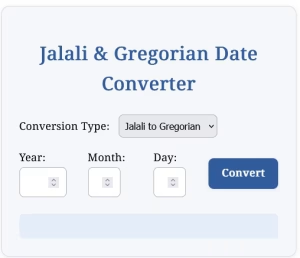
Jalali & Gregorian Date Converter
Jalali to Gregorian Converter – Free Online Tool
Convert Persian Calendar Dates Instantly & Accurately
Use our free Jalali to Gregorian converter to switch between the Persian (Jalali) and Gregorian calendars in seconds. Whether you’re planning international travel, managing cross-border business, or researching historical events, this tool delivers 100% accurate results with no signup required. Simply enter a date in either format and get the exact equivalent instantly.
What Is the Jalali (Persian) Calendar?
The Jalali Calendar, also known as the Persian Solar Hijri Calendar, is the official calendar in Iran and Afghanistan. Introduced in 1925 under Reza Shah Pahlavi, it is a highly accurate solar calendar based on precise astronomical observations.
Key Features of the Jalali Calendar:
- 12 months with Persian names (Farvardin, Ordibehesht, etc.)
- 6 months of 31 days, 5 months of 30 days, and Esfand with 29 or 30 days (leap years)
- Leap years follow a sophisticated 2820-year cycle with 683 solar years = 683×365.2422 days, making it more accurate than the Gregorian calendar
- Year 1 begins at the vernal equinox (around March 20–21 in the Gregorian calendar)
The calendar was originally designed in the 11th century by a team of astronomers led by Omar Khayyam, the famous Persian poet and mathematician, under the Seljuk Empire. The name “Jalali” comes from Sultan Jalal al-Din Malik Shah, who commissioned the reform.
What Is the Gregorian Calendar?
The Gregorian Calendar is the most widely used civil calendar globally. Introduced by Pope Gregory XIII in October 1582, it replaced the less accurate Julian Calendar.
Why Was It Created?
The Julian Calendar (introduced by Julius Caesar in 45 BCE) assumed a year was 365.25 days long. But the actual solar year is 365.2422 days. This caused a drift of about 10 days by the 16th century — meaning Easter was moving away from spring.
The Gregorian reform:
- Skipped 10 days (October 4, 1582 → October 15, 1582)
- Refined leap year rules: → A year is a leap year if divisible by 4 → Except if divisible by 100 (unless also by 400)
This keeps the calendar aligned with the solar year within one day every 3,300 years.
Why Convert Between Jalali and Gregorian?
Despite their differences, both calendars are solar-based and highly accurate — but they start at different points and use different rules.